


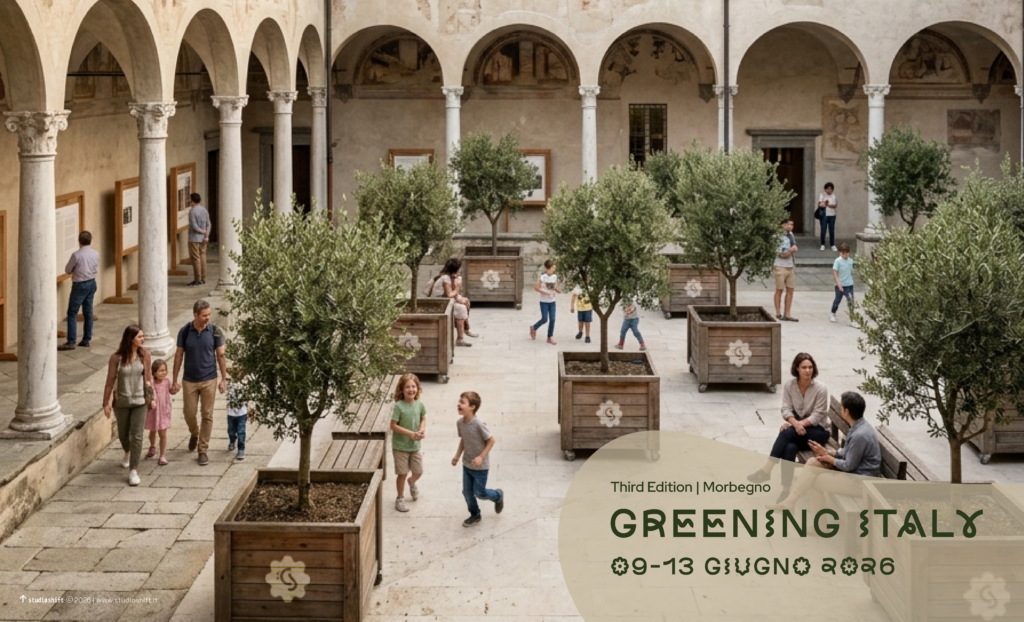
In 2026, to commemorate our first decade, Studio Shift is set to unveil a series of initiatives. These initiatives will not only reflect our journey but also forge new pathways for the future. Our goal is to honour projects that drive change at the juncture where community and just transition converge. A central role in this will be played by the third edition of Greening Italy, an event selected as a satellite of the New European Bauhaus Festival and the third stage of a journey that began in 2024.
The concept of Greening Italy originated in Bari with the project ‘Greening Italy – Verdeggiam l’Italia’, which was promoted by Studio Shift for the Italian Coordination Group of the Bosch Alumni Network (BAN) and was supported by IaC Berlin. From the outset, the initiative has brought together organisations from across Italy to explore urban greening practices that are rooted in local communities and inspired by the European Green Deal. This exchange resulted in the Greening Italy Manifesto and a shared roadmap for the three-year period from 2025 to 2027, which was signed by the participating organisations, including our friends at LaCapagrossa, Osun Wes and QG Enviro..
This approach has continued to evolve through subsequent projects by each organisation. For Studio Shift, we highlight the DS4Planet Festival, supported by the Ignite NEB programme, which generated ten ideas for reconnecting people with nature. Two of the winning ideas received further support from Studio Shift through the Grow NEB programme and were developed into prototypes, such as Valtellina 114: a community podcast exploring the relationship between climate change and territorial identity.
In 2025, the second Greening Italy event took place in Gibellina, Sicily. During a green and collaborative placemaking festival, the first Walking3 prototype was created in collaboration with the local community. This demonstrated the value of participatory, visible and replicable tools for urban greening.
Greening Italy comes to Morbegno
Morbegno will be the venue for the third edition of the event in 2026, which will see the Greening Italy initiative arrive in Lombardy.
The choice of location is no coincidence. Morbegno is home. This is where Studio Shift was founded. It continues to develop projects within its co-working space. However, it is also a symbolic territory. In recent years, the Valtellina region has undergone profound environmental changes, including ongoing urbanisation, increasing air pollution and climate fragility linked to accelerating glacier melt and associated hydrogeological risk. To these are added the more recent transformations brought about by the Winter Olympics, which are accelerating infrastructure development and increasing land consumption.
While these dynamics present opportunities, they also raise crucial questions about the territory’s future and the balance between the environment, community, and development.
What is Walking3?
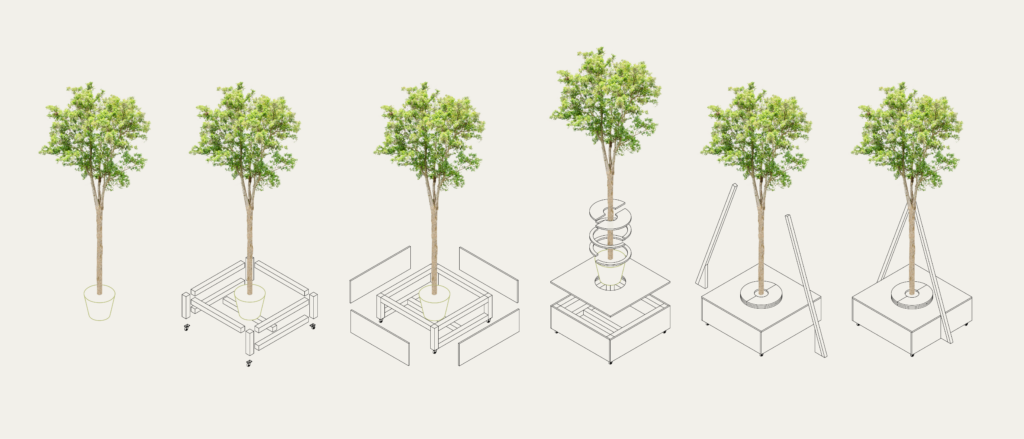
Walking3 is a mobile urban tree that symbolises climate justice and the ecological presence of cities. Created through participatory workshops with citizens, it is temporarily hosted in public spaces such as squares and school courtyards, becoming a platform for dialogue, education, and collective stewardship of the urban commons.
The benefits of urban trees extend far beyond CO₂ absorption: they reduce heat islands, improve air quality, support biodiversity, contribute to physical and mental wellbeing, and enhance the spaces themselves. On average, a single urban tree absorbs between 10 and 25 kg of CO₂ per year, depending on its species, age, and environmental conditions.
Walking3 makes this impact visible and shared: when citizens take part in its creation and care, climate action becomes concrete, local and collective.
The event thus embodies the principle of fostering a sense of belonging by actively involving the community in constructing the installation. In this process, citizens shift from passive observers to active stewards, developing a deeper connection with their territory and urban environment.
A project aligned with NEB Values
In line with the 2026 NEB Festival, we will focus on democratic engagement, showing how citizens can shape their own communities.
It’s not just about showcasing projects; it’s about living them. In line with the various Satellite initiatives and the NEB Festival‘s specific content (Brussels, 9–13 June), the third edition of Greening Italy translates into a tangible experience in which participants directly contribute to the design and prototyping of replicable, community-rooted solutions.
A distributed programme, between Morbegno and Milan
The programme for the third edition of Greening Italy runs from 9 to 13 June and is structured as a single narrative comprising meetings, workshops and opportunities for exchange.
As a prelude, on June 8 the workshop “Walking3: Public Space and Climate Justice” begins at the School of Design – Politecnico di Milano. Studio Shift will guide students in the customization and development of new variants of Walking3, which will be presented and voted on by the citizens of Morbegno by the end of the week. The initiative is offered by the School of Design as one of the professional workshop proposals within the Interior Design degree program, led by Professors Francesco Scullica and Elena Elgani.
On June 9, starting at 4:00 PM and in parallel with the official opening of the NEB Festival in Brussels, a Satellite Event takes place at the Chiostro di Sant’Antonio in Morbegno, dedicated to the exchange on community practices, civic activation, urban greening projects, and the enhancement of NEB initiatives developed at the local level.
The talk will be moderated by Elena Giunta, who will reflect on the first ten years of Studio Shift’s activity across territories and European networks. Speakers include:
- Giuseppe De Simone (Regional Coordinator Italy, BAN network) – Placemaking and Beyond: from the first Greening Italy Manifesto to the Fest-Val di Gibellina;
- Anna Gusmeroli (Municipality of Morbegno) – Morbegno as a “pilot city” between Alpine networks and the Budoia Charter;
- Francesco Scullica and Elena Elgani (Politecnico di Milano) – outcomes of the teaching lab “Design for Regenerative Hospitality”;
- Francesca Assi (TEH ExCom) – development trajectories of future urban and peri-urban cultural hubs;
- Alberto Vedovatti (Studio Shift) – community-led projects: Common Sounds;
- Simone Foscarini (RIFAI) – mobilization of inner areas and the experience of the Scuola di Politiche.
Participation is free. In-person registration here.
To follow the event online, please join via Google Meet: Join the online event
Following the talk, the exhibition “Design for Regenerative Hospitality” will be inaugurated, presenting the outcomes of the Metaproject Laboratory curated by Francesco Scullica and Elena Elgani, and developed in collaboration with the School of Design – Politecnico di Milano and the Municipality of Morbegno.
June 10 is dedicated to the realization of the full-scale Walking3 prototype in Morbegno, thanks to the valuable support of ColorLak, Falegnameria Dell’Oca, and the florist “La Rosa” by Tarabini Roberta. A hands-on field day that transforms design ideas into a concrete installation experienced by the community.
In parallel, at the School of Design of the Politecnico di Milano, student teams will be working on the assembly of the small-scale prototypes of the Walking3 variants and on the production of communication materials supporting the final project presentation.
On June 11, the third and final co-design session led by Studio Shift takes place for the Filarmonica of Ponte in Valtellina. Within the framework of the Common Sounds project (supported by the Co-create NEB program), the Filarmonica and its community reflected on how to design the “Courtyards of Music” to support education and cultural enjoyment of the local band heritage. Together, we will self-build the spatial installation of the Garden, based on the design developed between April and May. On the same day, we will welcome the Italian representatives of the BAN (Bosch Alumni Network) for further exchange and site visits.
On June 12, the workshop “Walking3: Public Space and Climate Justice” concludes. Starting at 2:30 PM at the Chiostro di Sant’Antonio in Morbegno, students from the School of Design of the Politecnico di Milano will present the prototypes developed during the design process to citizens and a jury of experts. This is an open moment of public discussion to explore new visions and solutions for public space and the challenges of climate justice. Participation is free.
On June 13, the cycle of events concludes at the Casa della Cultura in Talamona, with a public day dedicated to project restitution and exchange between European networks working on territorial regeneration.
During the day, the final talk takes place, in dialogue with the closing of the NEB Festival in Brussels, bringing together European networks and speakers engaged in shared themes of territorial regeneration. Speakers include:
Filarmonica di Talamona, with the launch of the “Library of Tools” service, an action of the Common Sound project; Giuseppe De Simone (BAN), on the Greening IT Manifesto and placemaking with the Fest-Val di Gibellina; Ivan Iosca (LaCapagrossa), on the design of the Walking3 project; Hanna Rasper, on “Seeds in Southern Europe”; Andrea Giacomelli (pibinko.org), on twenty years of interdisciplinary experiences reconnecting territories; Giulia Sala (Placemaking Italia), sharing experiences of rural placemaking; Giuseppe Scandone (QG Enviro), with the Community Festival and the concept of “Restanza”; Lorenza Salati and Giulio Focardi (Osun Wes), on the Post-Industrial Forest and Future Laboratories; and Giorgia Floro (Placemaking Impact Cluster), presenting the Children’s City experiment.
We look forward to seeing you!
Camilla Rui – April 2, 2026

Make a Shift is Studio Shift's e-magazine, focused on design and social innovation, where you can find articles and case histories of our projects.
Go to articles