


The Unlock Your Sprint – Design Festival took place on 16–17 January 2026 at the Collegio Carlo Alberto in Turin. As part of the Unlock Programme and the Città dell’Educazione 16+ initiative, the festival aimed to strengthen the capacity of territorial networks to engage with and guide young people aged 16–29, particularly those who are ‘on the threshold’ — in a phase of transition, exploration or redefinition.
Promoted by Fondazione Compagnia di San Paolo and designed and led by Studio Shift, the Festival was conceived not as a simple ideation event, but as a structured working space to test concrete solutions capable of engaging with the existing ecosystem and evolving beyond the prototyping phase.
In a context where pathways towards employment are increasingly fragmented and non-linear, the fundamental question was not ‘What new opportunities can we create?’, but ‘How can we make existing opportunities more accessible, understandable, and actionable?’ And how can we design tools and services that truly connect young people and local territories?
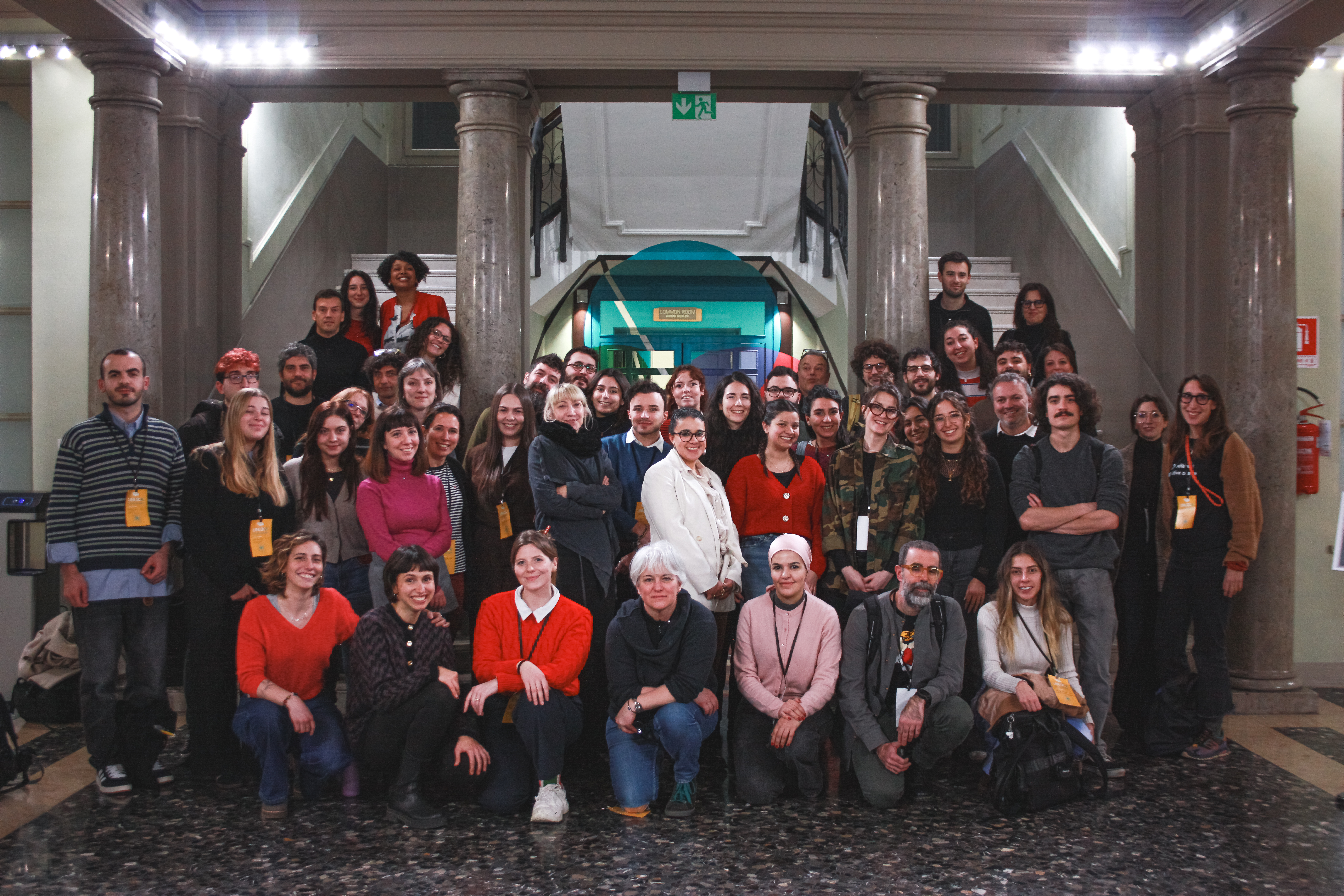
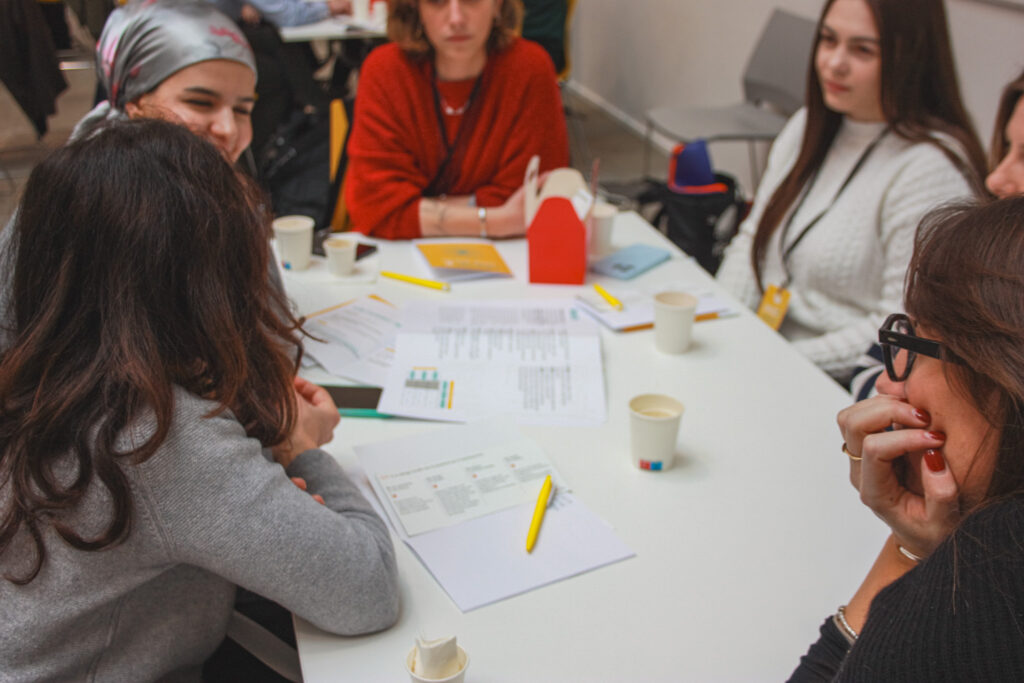
Over fifty participants, including designers, social sector operators, young people and innovation professionals, worked intensively for two days on five design briefs developed from ‘How Might We’ questions that emerged from a prior desk and field research phase.
The Design Sprint Method in the Unlock Framework
For this occasion, Studio Shift applied its Design Sprint format, which was adapted within the framework defined by the research phase (map & target). The focus was on solution development (sketch & decide), making the transition from intuition to project proposal faster and more deliberate.
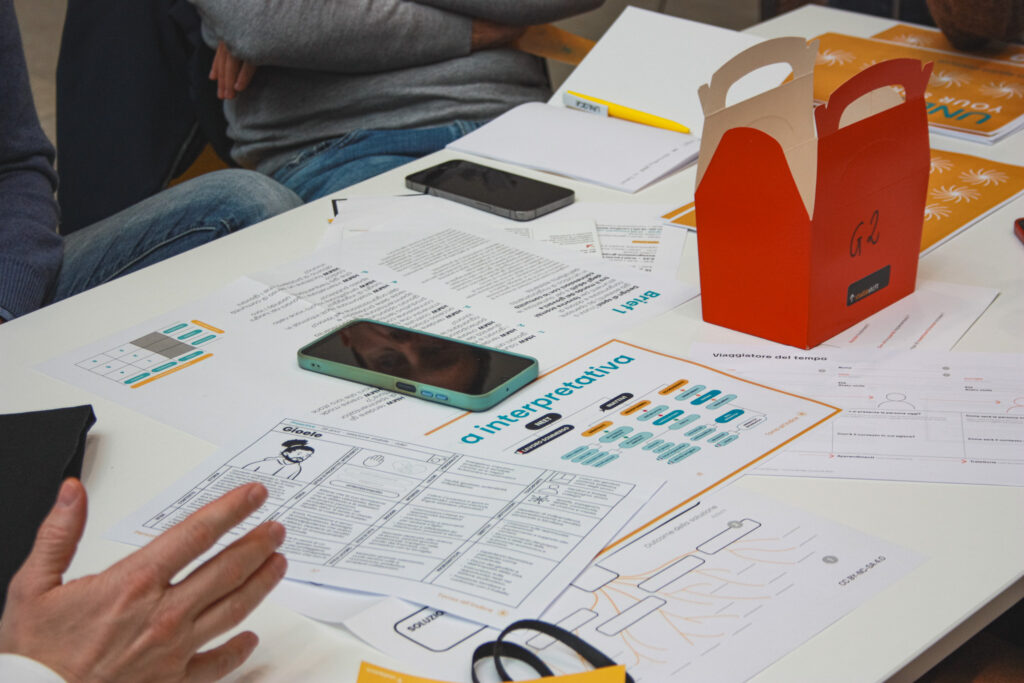
Several targeted design tools were made available at the workshop tables, including personas derived from the research, an idea tree to clarify the transition from problem to solution, a value proposition to define target groups and positioning, idea postcards to outline functionality, resources and implementation conditions, and a time traveller tool to test how the proposal might evolve in relation to its intended audience.
Working teams were supported in clarifying design choices and verifying coherence and feasibility through structured exchanges with tutors, mentors and experts (clinics). At the same time, the interdisciplinary and intergenerational composition of the groups enabled solvers, social operators and young people — including those ‘on the threshold’ — to address the same challenge together, combining diverse skills, knowledge and experiences. Languages, cultural references and interpretative frameworks intertwined in genuine exchange, resulting in proposals that were more robust and context-aware.
The Jury and the Winning Proposals
The ten proposals developed during the festival were presented at a public pitching session. They were evaluated according to the following criteria: quality; alignment with the objectives of Unlock; level of innovation; feasibility; and long-term impact potential.
The jury included: Marzia Sica (Head of People Goal, Fondazione Compagnia di San Paolo); Michele Osella (Head of Innovation, Fondazione Compagnia di San Paolo); Elena Giunta (CEO and Head of Design, Studio Shift); Raffaella Nervi (Regional Orientation Representative, Regione Piemonte); Monica Lo Cascio (Director, Area 1, Città di Torino); Cristina Biella (Cultural Project Manager, KERNEL Studio Società Cooperativa).
Of the ten ideas presented,NEMO Cosa vuoi fare da grande? (NEMO – ‘What do you want to be when you grow up?‘) – and JOBX Orienta. Prova. Lavora. (JOBX – ‘Orient.’ Try. Work) were selected as winners.
In particular, NEMO addresses the issue of fragmented information. Training opportunities, job offers, public calls and events are often scattered across different and hard-to-understand channels. The proposed solution is an AI-based guidance assistant conceived as a conversational interface that can translate needs and aspirations into dynamic search criteria. Through semantic matching, NEMO acts as a mediator, highlighting less visible opportunities and connecting users to real territorial touchpoints. Guidance thus becomes an iterative and personalised process.
JOBX, on the other hand, brings guidance back into concrete experience. It is based on short real-work tasks proposed by companies, comprising modular micro-experiences in which young people and businesses collaborate to solve real-life challenges. Supported by guidance professionals, participants can identify and develop the emerging competencies, transforming the experience into an active step in their career development. The proposal focuses on the relational and intergenerational dimension, reducing distances and fostering a more balanced exchange between generations.
Both projects will have access to an implementation support pathway equivalent to €5,000 worth of services, provided by Studio Shift in collaboration with KERNEL Studio Società Cooperativa. Fondazione Compagnia di San Paolo also reserves the possibility of providing further financial support for subsequent implementation phases.
Beyond Ideas: What Emerges and What Remains
This experience clearly shows that services for young people do not necessarily need to be radically new to be attractive; rather, they need to be rethought in terms of the ecosystem in which they operate and how they are made accessible.
The proposed ideas — even those not selected — addressed very specific issues: the fragmentation of information, the perceived distance between young people and companies, the difficulty of translating informal competencies into recognised value, and the need for relational tools that engage before guiding. In this sense, the festival functioned as a true research and observation field, addressing key questions such as: where do pathways break today? Where does the gap between opportunities and young people emerge? Which transitions need to be reconsidered?
Dialogue between different skills and generations broadened the interpretation of the theme, challenging implicit representations of work such as the idea that stability is the only desirable goal, the fear of risk, the management of error and the relationship between individual expectations and the real opportunities offered by the territory. This was not a theoretical debate, but rather a practical confrontation that forced the proposals to be evaluated against diverse perspectives and shared responsibilities.
The outcome is not only the projects themselves, but also a new way of working: designing with and for networks, involving both service providers and users.
The support pathway now beginning for NEMO and JOBX represents the continuation of this process, as well as the challenge of testing the robustness of the emerging proposals and their capacity to generate relationships between young people, companies and local territories in real contexts.
March 13, 2026

Make a Shift is Studio Shift's e-magazine, focused on design and social innovation, where you can find articles and case histories of our projects.
Go to articles