


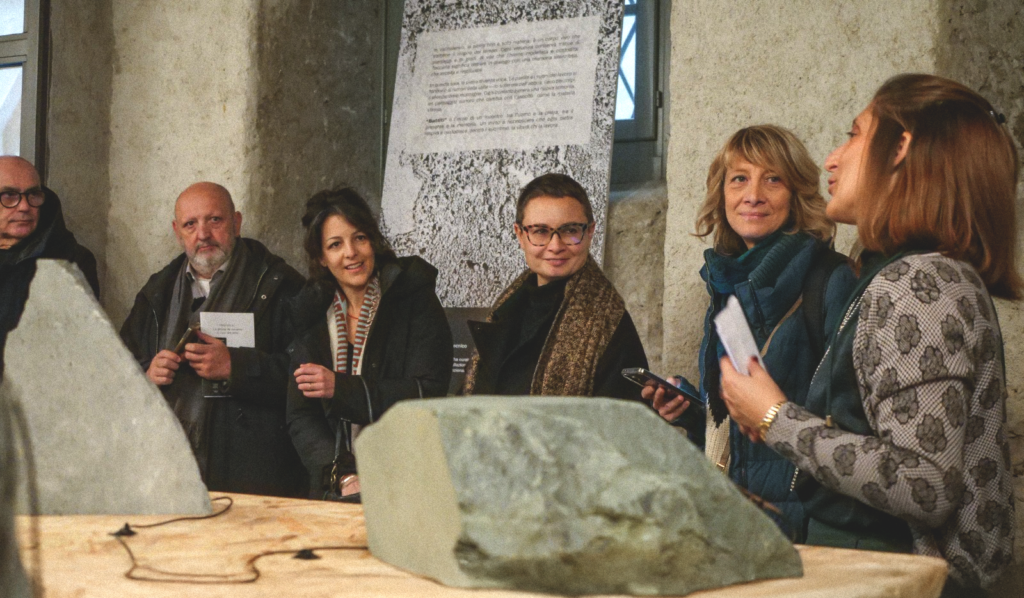
After seven months of field research, listening, and co-design, the project “Modellare il Tempo. Living Heritage in the Alpine Territory” reached its public conclusion in Valtellina with the exhibition “Corpi di Pietra”, inaugurated on December 13, 2025 at the Sala delle Acque of BIM Adda in Sondrio.
Thanks to the facilitation and technical direction provided by Studio SHIFT, the initiative explored the intangible heritage of stone craftsmanship, offering a contemporary interpretation capable of holding together memory, body, and future.
A project on Alpine Living Heritage
Modellare il Tempo was developed within regional policies aimed at safeguarding and transmitting intangible cultural heritage, in line with the UNESCO Convention for the Safeguarding of the Intangible Cultural Heritage. The project was promoted by the Archive of Ethnography and Social History (AESS) of the Culture Directorate of Regione Lombardia, together with ERSAF and Codici Ricerca e Intervento.
Officially launched in Milan in May, the project involved five young creatives under 35 (Andrea Pugliese, Alice Greggio, Tobia Invernizzi Martini, Luca Toscano, and Giorgia Navarra), who were invited to immerse themselves in the productive contexts of Valmalenco: active quarries, historic workshops, traditional sites, as well as industrial and contemporary production spaces.
Three field missions allowed them to observe, listen to, and inhabit the gestures of artisans, transforming lived experience into design material.
“Corpi di Pietra”: an experiential exhibition
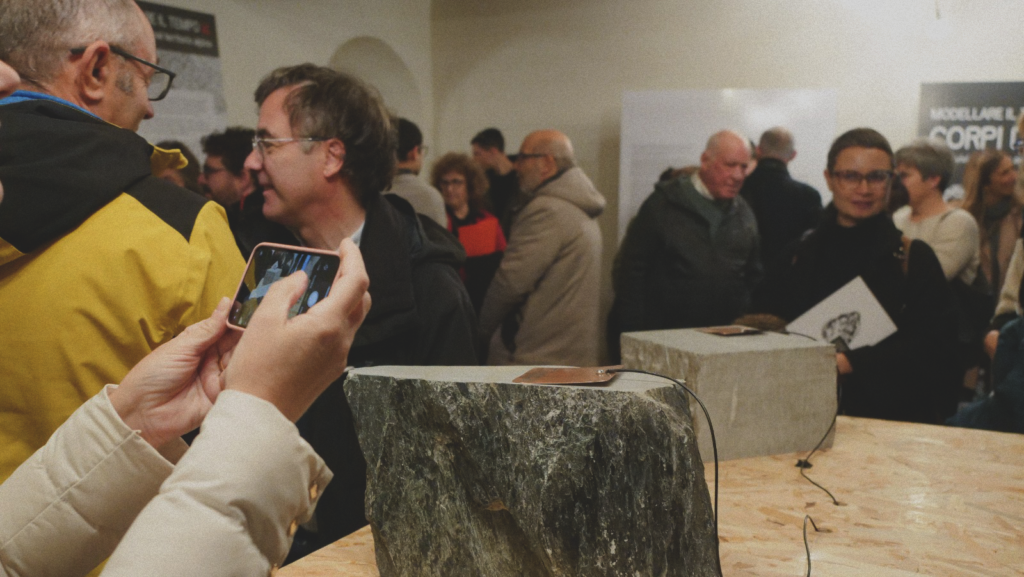
The exhibition “Modellare il Tempo in Valmalenco. Corpi di Pietra. Living Knowledge and Craft Practices of Stone Working” is the outcome of this collective process. It is an interactive installation that weaves together sound, image, words, and gestures, restoring the living dimension of both artisanal and non-artisanal work.
The exhibition unfolds through three installations, conceived as parts of a single sensitive landscape:
- BATTITI: an interactive table hosts four stones representing the different types worked by the community of practice. Thanks to a sensor placed above each stone, touching them activates soundscapes collected during the research: chisel strikes, quarry noises, artisans’ voices. An invitation to “listen to stone with your hands,” restoring physicality and rhythm to a material often perceived as inert.
- MEMORIE: four walk-through banners display excerpts from the research diary produced during the field visits. The installation is completed by a reading area where visitors can access the full narrative, collected in a small book in which an imagined young voice recounts the encounter with the valley through the gestures of artisans. The body becomes a place of learning, a living archive of knowledge transmitted through practice.
- FRAMMENTI: an audiovisual montage alternates archival images with macro shots of stone working, landscape views, and field recordings. Time slows down, gestures repeat, stone seems to breathe. It is a visual narrative that connects matter, body, and memory.
Beyond the exhibition: an ongoing process
The exhibition marks the conclusion of the journey of discovery and enhancement of stone craftsmanship in Valmalenco, but not the end of the Modellare il Tempo project. Materials, stories, and installations will form the basis for new actions of storytelling and transmission of Alpine knowledge, continuing also in Milan throughout 2026.
Within the Modellare il Tempo framework, another territory has also been activated: Val Camonica, which will host a similar event in the coming months dedicated to wood craftsmanship. Because “intangible heritage is not something to be preserved in a display case, but a living practice that renews itself through dialogue.”

Make a Shift is Studio Shift's e-magazine, focused on design and social innovation, where you can find articles and case histories of our projects.
Go to articles